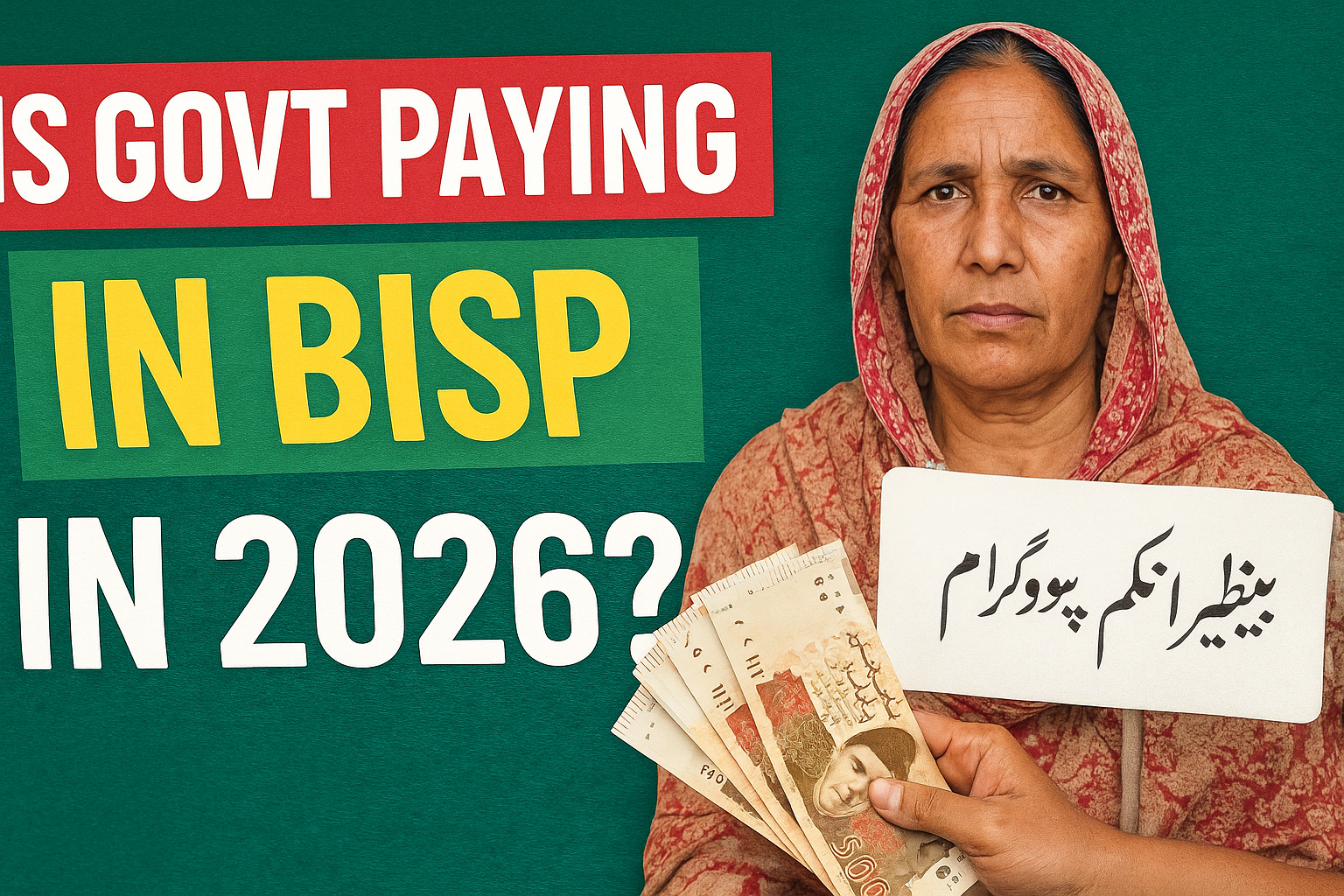
Is Government Paying Public under Benazir Income Support Programme (BISP) in 2026? — What You Should Know
Social welfare in Pakistan often raises an important question: “Is the government still disbursing funds under BISP in 2026?” The short answer: Yes — as of 2025 and going into 2026, the government continues to pay eligible beneficiaries under BISP, subject to updated rules, verification, and eligibility criteria. In this article, we explore the latest status of BISP payments, what has changed recently, and how you can check or claim payments if you are eligible.
📌 What is BISP and Who It Helps
-
BISP is Pakistan’s flagship social safety-net programme aimed at providing cash transfers to low-income and vulnerable families, especially women (heads of households), to meet basic needs like food, healthcare, and education.
-
BISP’s “Kafaalat” scheme has been the main channel for quarterly cash stipends to eligible beneficiary households. 8171.bispwebportal.com.pk+2bisponline.pk+2
-
Over the years, BISP has undergone reforms including updated beneficiary verification (through national databases and surveys), improved disbursement channels (banks, biometric verification), and periodic review of eligibility. jbms.pk+2bisp-g0v.pk+2
Thus, BISP remains the primary tool through which the government supports the most vulnerable families in Pakistan.
✅ Are Payments Ongoing in 2025–26?
Yes — payments under BISP are currently active as per the latest public updates:
-
Recently, the government restored payments for “old beneficiaries” whose disbursements had been paused due to data mismatches, expired identity documents, or incomplete verification. jbms.pk+2My Blog+2
-
According to an official update, BISP payments in late 2025 have been distributed in various districts across provinces, indicating that the system is functioning. jbms.pk+2bisponline.pk+2
-
Payment methods include biometric verification, bank transfers, and disbursement through authorized centers — making access easier and more secure. bisp-g0v.pk+2bisponline.pk+2
Hence, if you are an eligible and verified beneficiary — yes, the government is paying.
💵 What Is the Payment Amount in 2026?
One of the significant recent changes relates to the stipend amount:
-
In 2025, eligible households under BISP Kafaalat received quarterly payments of Rs 13,500. Maryam Nawaz Collective Marriages Program+28171.bispwebportal.com.pk+2
-
As per official announcements, from January 2026 onwards, this amount is being increased to Rs 14,500 per quarter. 8171.bispwebportal.com.pk+28171news.org.pk+2
-
The increase comes as a response to inflation and rising cost of living, aiming to improve beneficiaries’ purchasing power. 8171.bispwebportal.com.pk+2My Blog+2
Therefore, beneficiaries who meet eligibility and verification criteria should receive the updated amount once payments resume in 2026.
🔄 Why There Were Interruptions — and What Changed
Not all registered beneficiaries received payments consistently in recent years. There were several reasons for suspension or delays:
-
The government carried out a “dynamic survey” and re-verification process (including identity verification, income/assets check, data validation with national registries) to ensure only deserving families remain on the list. Maryam Nawaz Collective Marriages Program+2jbms.pk+2
-
Cases of expired or wrong documentation (e.g., CNICs), incomplete data (household survey info), or changed economic status (household became non-poor) led to temporary suspension for some beneficiaries. jbms.pk+2Maryam Nawaz Collective Marriages Program+2
-
After re-verification and updated data integration (with institutions like NADRA and National Socio‑Economic Registry (NSER)), many old beneficiaries were reactivated and added back to the payment roster. jbms.pk+1
Thanks to those reforms, BISP seems to have improved transparency and targeting — but it also means eligibility and documentation must be up to date.
📲 How to Check Your BISP Payment Status (2025–26)
If you want to verify whether you are eligible or check the status of your BISP payment, here are the official ways:
-
Use the official BISP payment portal (often referred to as “8171 portal”) to enter your CNIC number for status check. 8171.bispwebportal.com.pk+2bisponline.pk+2
-
Alternatively, send your 13-digit CNIC via SMS to “8171” (the official BISP SMS service) — you’ll receive a reply indicating whether payment is due or available. bisponline.pk+1
-
For receiving payment: beneficiaries can go to authorized banks/ATMs (e.g., banks partnered with BISP) or biometric-enabled payment centers/camps. For remote or rural areas, mobile vans or BISP local centers are sometimes used. bisp-g0v.pk+2bisponline.pk+2
These steps help ensure that support reaches genuine and eligible families — and avoid fraud or misuse.
📑 What to Watch Out For — Conditions & Eligibility
Still, it’s important to understand that not everyone automatically receives BISP payments. Key conditions include:
-
Valid and up-to-date CNIC (or identity documents) and accurate household data registered with NSER. Maryam Nawaz Collective Marriages Program+2jbms.pk+2
-
Eligibility under the poverty means test (PMT) or other criteria — households above certain income/asset thresholds might be disqualified. 8171.bispwebportal.com.pk+2My Blog+2
-
Successful biometric verification (thumbprint or other method) when collecting payment. bisp-g0v.pk+1
-
For those who were previously suspended or excluded, completion of re-verification (survey update, documentation, NSER data) to get reinstated. jbms.pk+2My Blog+2
Families who do not meet these requirements — or have not updated their data — may not receive payments even if they were once beneficiaries.
📰 Government Commitment & Expansion Plans in 2025–26
Recent developments suggest the government remains committed to BISP and aiming to expand its support:
-
In the budget for fiscal year 2025–26, a substantial allocation (reportedly around Rs 716 billion) was proposed for BISP, reflecting intention to expand coverage and support more low-income families. NEWS.com.pk
-
The plan reportedly includes extending coverage to additional poor households, especially women-headed families, and increasing the number of beneficiaries via updated surveys and registrations. 8171.bispwebportal.com.pk+2NEWS.com.pk+2
-
Efforts are underway to digitize and streamline payment delivery (via bank accounts, fintech solutions, mobile wallets, etc.), and to train beneficiaries in using such systems — especially useful for remote or underserved areas. UrduPoint+1
These developments suggest BISP is not only continuing, but adapting to evolving economic challenges and aiming for broader, more transparent outreach.
📝 What This Means for People in 2026 — Especially in Rural or Low-Income Areas
For many Pakistani families — particularly in rural areas or among marginalized communities — the continuation and enhancement of BISP payments in 2025–26 can be a crucial lifeline. The increase to Rs 14,500 per quarter, combined with more efficient distribution via banks and biometric verification, means:
-
Better financial support to cover household essentials (food, education, healthcare) during inflationary times.
-
More predictable and secure disbursement — reducing need to travel far for payments, thanks to banking and digital infrastructure.
-
Greater inclusion of deserving families through updated surveys and data — potentially benefiting households who were previously excluded due to outdated or incorrect information.
At the same time, beneficiaries must ensure they are registered, updated, and verified — outdated documentation or failure to re-verify may lead to payment denial even in 2026.
✅ Conclusion: Yes — But With Responsibility & Verification
In summary: the government is paying public under BISP in 2025–26, and plans for 2026 suggest continuation with improved structure, better disbursement, and expanded outreach. However, eligibility, verification, and accurate documentation remain critical.
If you believe your family should receive BISP support, it’s advisable to check your status via the official 8171 portal or SMS service, ensure your CNIC and household data are valid, and follow the correct payment collection method (bank, biometric center, or authorized outlet).